




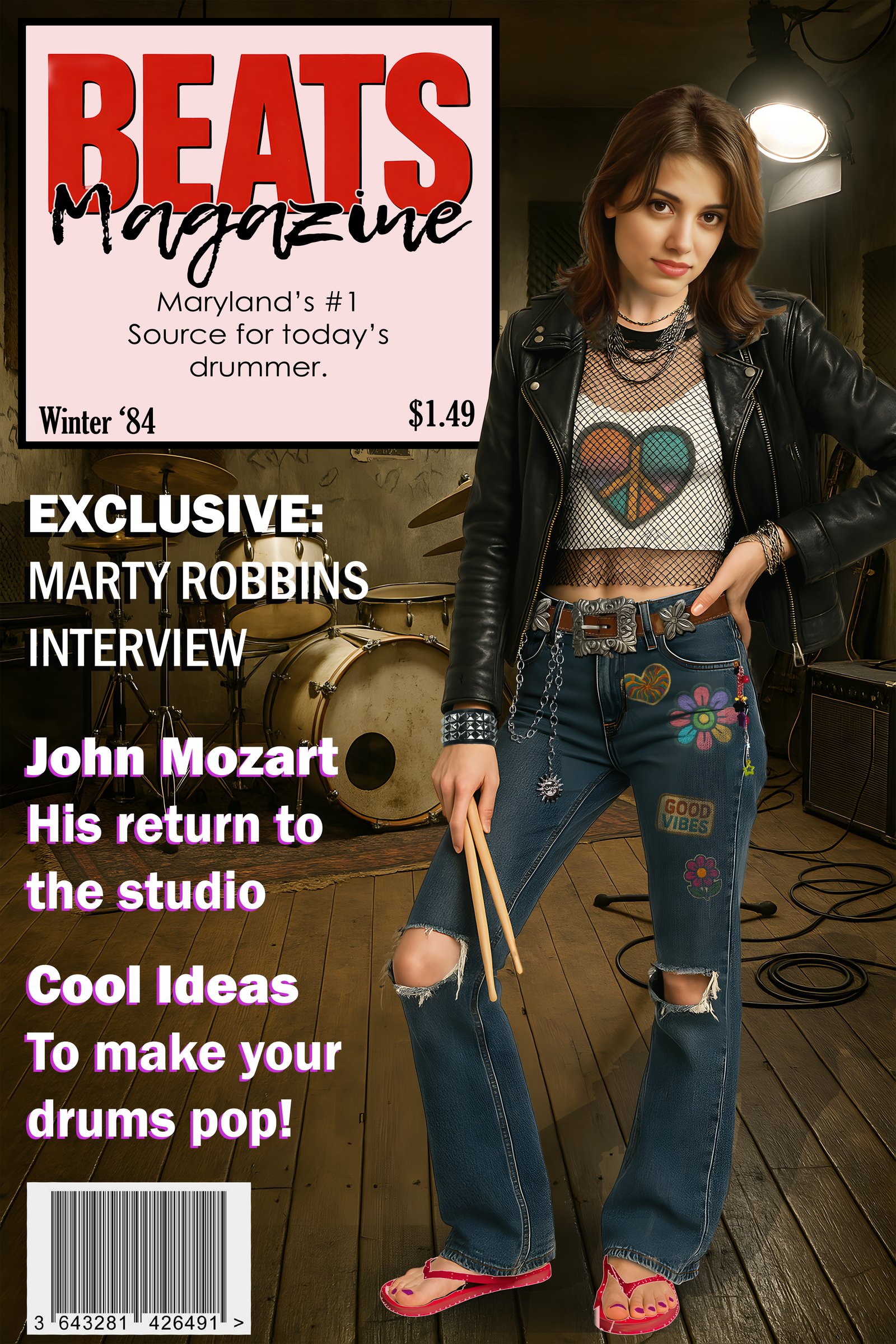
Drumming With Marty
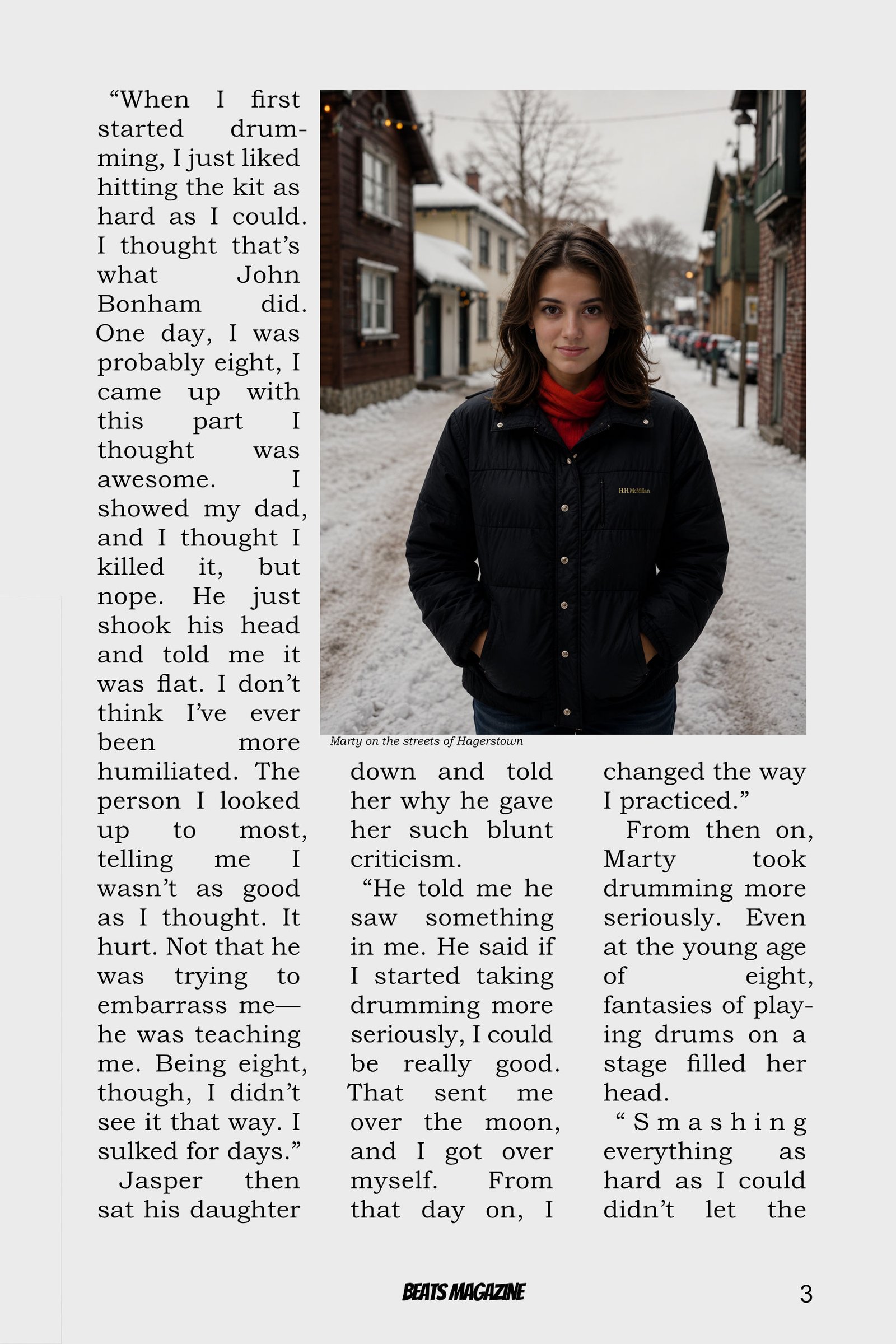
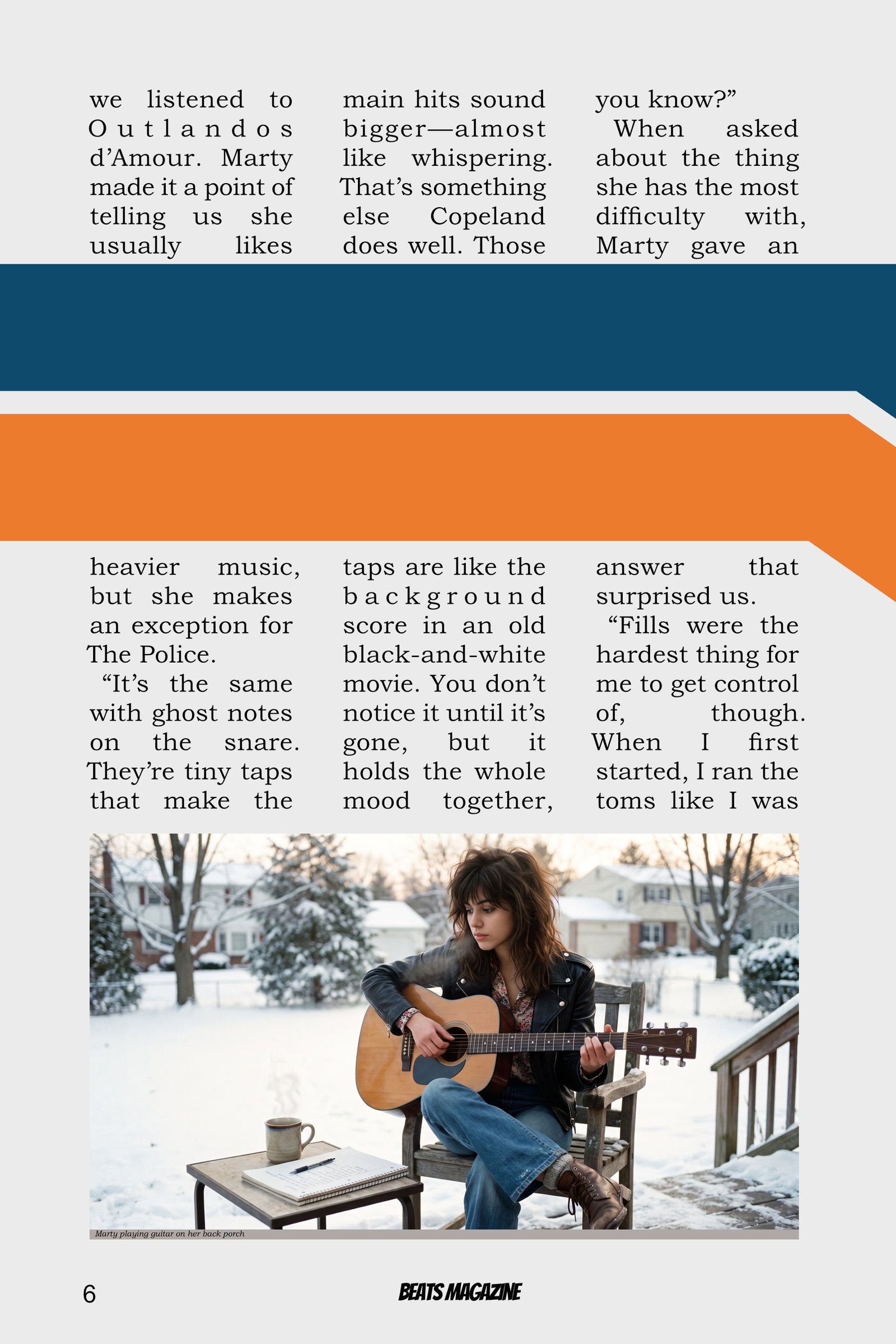
At just seventeen years old, Marty Robbins plays like an old pro, leaning hard into groove, texture, and discipline without losing the restless energy of youth. Some of this could be in her genes. Coming from a lineage of drummers, Marty has become the rhythmic backbone of The Allurettes, the all-girl house band at Strawberry Rockets Drive-In Theater in Hagerstown, Maryland.
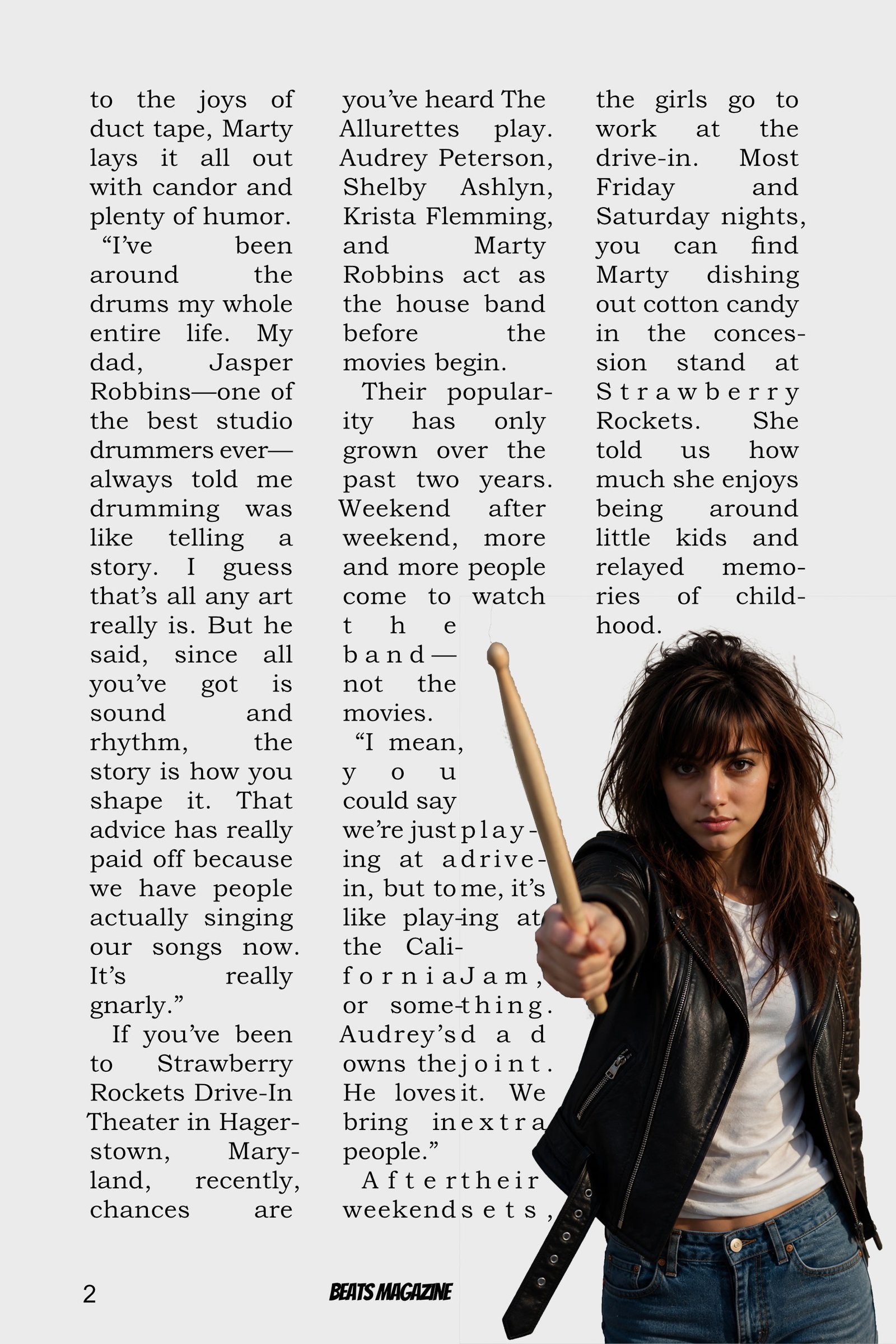
The girl who loves wearing her leather jacket plays like a drummer twice her age, yet still loves garage rehearsals and covering old Sabbath songs. She talks about ghost notes and hi-hat splashes with the same excitement most teens reserve for MTV discussions. And while she’s still shaping her sound, Marty already knows what she doesn’t want: sterile, mechanical beats. For her, the drums have to breathe. They have to make the music blast off.
We sat down with Marty in the middle of a hectic week of rehearsals and photo shoots to talk shop. From her thoughts on restraint in fills to the joys of duct tape, Marty lays it all out with candor and plenty of humor.
“I’ve been around the drums my whole entire life. My dad, Jasper Robbins—one of the best studio drummers ever—always told me drumming was like telling a story. I guess that’s all any art really is. But he said, since all you’ve got is sound and rhythm, the story is how you shape it. That advice has really paid off because we have people actually singing our songs now. It’s really gnarly.”
If you’ve been to Strawberry Rockets Drive-In Theater in Hagerstown, Maryland, recently, chances are you’ve heard The Allurettes play. Audrey Peterson, Shelby Ashlyn, Krista Flemming, and Marty Robbins act as the house band before the movies begin.
Their popularity has only grown over the past two years. Weekend after weekend, more and more people come to watch the band—not the movies.
“I mean, you could say we’re just playing at a drive-in, but to me, it’s like playing at the California Jam, or something. Audrey’s dad owns the joint. He loves it. We bring in extra people.”
After their weekend sets, the girls go to work at the drive-in. Most Friday and Saturday nights, you can find Marty dishing out cotton candy in the concession stand at Strawberry Rockets. She told us how much she enjoys being around little kids and relayed memories of childhood.
“When I first started drumming, I just liked hitting the kit as hard as I could. I thought that’s what John Bonham did. One day, I was probably eight, I came up with this part I thought was awesome. I showed my dad, and I thought I killed it, but nope. He just shook his head and told me it was flat. I don’t think I’ve ever been more humiliated. The person I looked up to most, telling me I wasn’t as good as I thought. It hurt. Not that he was trying to embarrass me—he was teaching me. Being eight, though, I didn’t see it that way. I sulked for days.”
Jasper then sat his daughter down and told her why he gave her such blunt criticism.
“He told me he saw something in me. He said if I started taking drumming more seriously, I could be really good. That sent me over the moon, and I got over myself. From that day on, I changed the way I practiced.”
From then on, Marty took drumming more seriously. Even at the young age of eight, fantasies of playing drums on a stage filled her head.
“Smashing everything as hard as I could didn’t let the song breathe—the dynamics were all out of whack. Since that rough lesson, I’ve been learning about dynamics. If I play soft in a verse, just tip-tapping the hi-hat and ghosting the snare, then crack down in the chorus, the whole song explodes. People feel that contrast, even if they don’t know the technical side.”
People are feeling it, too. During our visit with her, we had an opportunity to catch a rare winter show. We saw more than a few children and adults playing air drums to the beat.
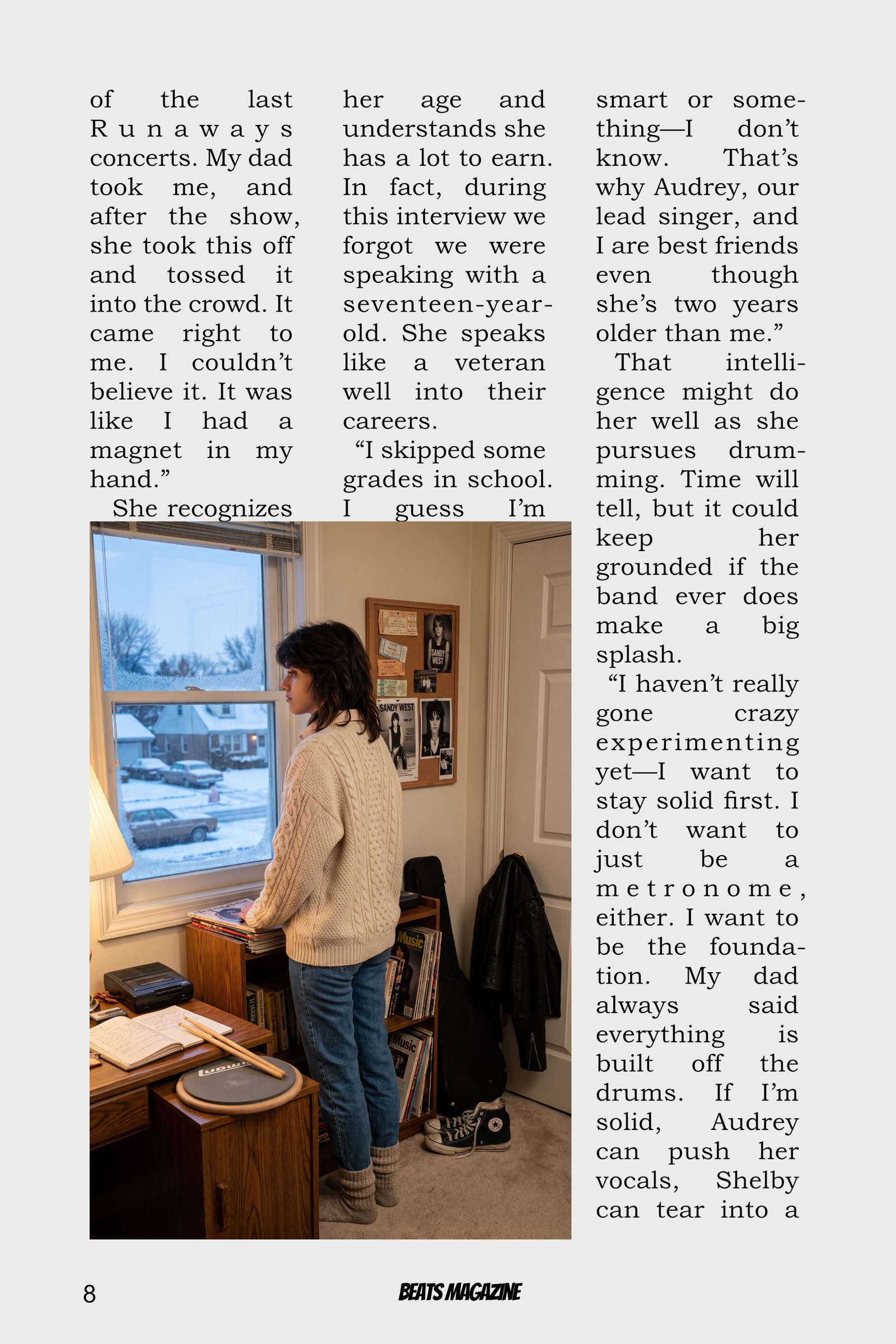
“I wanted so badly to be like Sandy West. I love her—she’s my favorite drummer ever. From her I learned how to control power, so the hits stay alive instead of sloppy. Then there’s Stewart Copeland—totally different from Sandy, but still a genius. Trying to play like him taught me so much about the hi-hat. Nobody textures a song with it more than he does. And the way he builds tension with crescendos—hitting harder and harder without even changing the pattern. Listening to The Police—that’s what brought my dad’s lesson full circle for me. It’s awesome.”
Other musical influences include John Bonham, Bill Ward, Denise Dufort, Hal Blaine, and Ginger Baker. It goes without saying, her dad tops this list.
“That’s probably why I mess around with the hi-hat so much—because of The Police. Most people think it’s just open or closed, but there’s a whole world in between. Half-open, splashing with your foot, choking it right after a strike, dragging the stick across the edge so it shimmers or sizzles—whatever word I’m looking for—drummers will know what I’m trying to say. Those little textures are what make a groove feel alive.”
Speaking of Stewart Copeland, on the ride to Strawberry Rockets, we listened to Outlandos d’Amour. Marty made it a point of telling us she usually likes heavier music, but she makes an exception for The Police.
“It’s the same with ghost notes on the snare. They’re tiny taps that make the main hits sound bigger—almost like whispering. That’s something else Copeland does well. Those taps are like the background score in an old black-and-white movie. You don’t notice it until it’s gone, but it holds the whole mood together, you know?”
When asked about the thing she has the most difficulty with, Marty gave an answer that surprised us.
“Fills were the hardest thing for me to get control of, though. When I first started, I ran the toms like I was proving something every two bars. Listening to Charlie Watts taught me how much space matters—sometimes the best fill is no fill at all. These days, I want a fill to mean something. Like Phil Collins in Genesis—his fills are more like commas or semicolons than exclamation points. More emotional, I think. They connect thoughts instead of shouting over them.”
Then again, maybe fills—usually the most fun part of a drummer’s repertoire—would be the most difficult part for someone who exudes so much energy and excitement to get control of. Just sitting with her gives you a sense of movement. Exhilaration reverberates off her like mist off a waterfall.
“Take our song, ‘Summer Songs’. I wait until the end of the chorus for my first fill—just a tom run with a crash. That way it feels like a kick-ass intro to Shelby’s solo. It’s tough because I want to show off all the time, but that doesn’t make the band better. What makes the band better are grooves that feel restrained.”
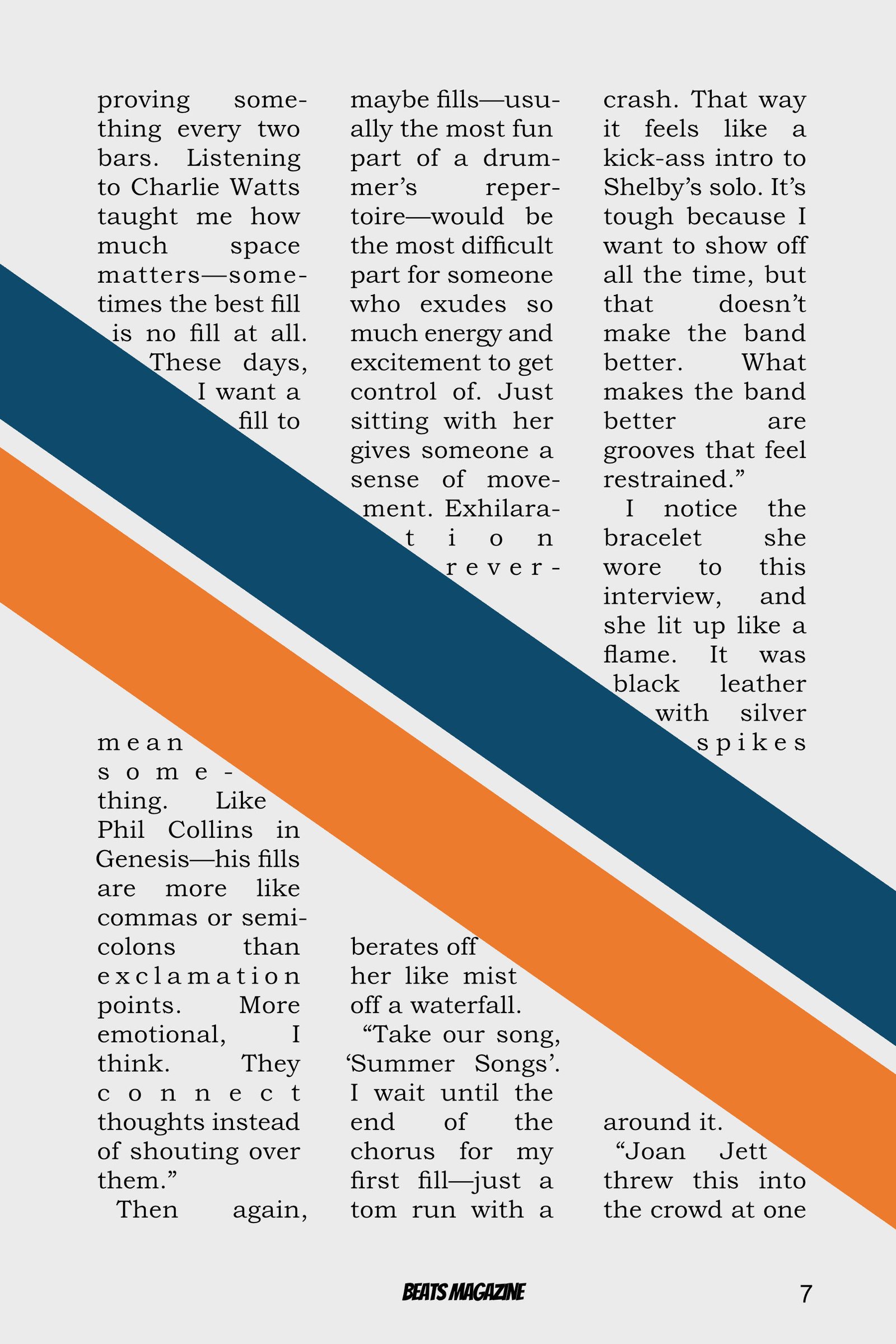
I notice the bracelet she wore to this interview, and she lit up like a flame. It was black leather with silver spikes around it.
“Joan Jett threw this into the crowd at one of the last Runaways concerts. My dad took me, and after the show, she took this off and tossed it into the crowd. It came right to me. I couldn’t believe it. It was like I had a magnet in my hand.”
She recognizes her age and understands she has a lot to earn. In fact, during this interview we forgot we were speaking with a seventeen-year-old. She speaks like a veteran well into their careers.
“I skipped some grades in school. I guess I’m smart or something—I don’t know. That’s why Audrey, our lead singer, and I are best friends even though she’s two years older than me.”
That intelligence might do her well as she pursues drumming. Time will tell, but it could keep her grounded if the band ever does make a big splash.
“I haven’t really gone crazy experimenting yet—I want to stay solid first. I don’t want to just be a metronome, either. I want to be the foundation. My dad always said everything is built off the drums. If I’m solid, Audrey can push her vocals, Shelby can tear into a solo, and Krista can lock down the low end without looking over their shoulders.”
That’s the drummer’s job, after all: make your band feel safe enough to go wild. When that happens, any band can sound bigger than they really are.
“At the end of the day, I just hope people hear my personality in my playing. Not just, ‘oh, that’s The Allurettes’ drummer.’ I want them to feel about me the way I feel listening to Sandy West, or Ginger Baker, or Gary Driscoll. Because I can’t sing, the drums are my voice. If people know me through the kit, then I know I’m on the right path.”